
 11
11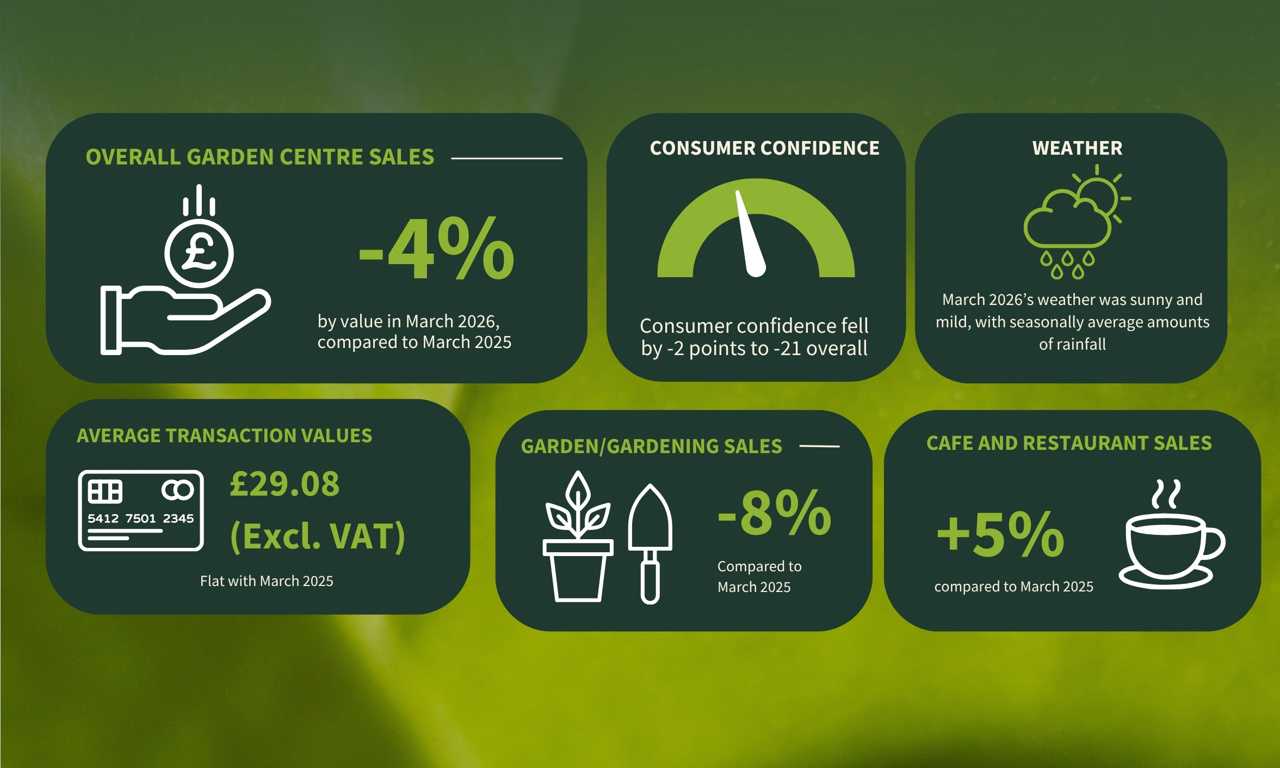
Garden centre sales fell by 4% in March 2026 compared March 2025, according to the latest Horticultural Trades Association Market Update, as trading conditions shifted back towards more typical seasonal patterns following an unusually strong 2025.
Despite the year-on-year decline, sales remained 18% higher than March 2024, when colder and wetter weather significantly dampened demand across the sector.
The Horticultural Trades Association (HTA) said the figures reflect a combination of milder but more variable weather, late-March overnight frosts, and the earlier timing of key retail periods such as Easter and Mother’s Day. Overall customer footfall also fell, with total transactions down 4%. Gardening categories were the most affected, with sales down around 8% year on year. Bedding plants declined by 9%, while hardy plants fell by 11%.
HTA Director of Policy and Public Affairs Jennifer Pheasey, explained: “March reflects a return to more typical seasonal trading conditions after the very strong performance we saw last year. Sales are down 4% on 2025, but still 18% ahead of 2024, when much wetter and colder weather held back demand. The contrast across these three years highlights just how influential weather remains on our sector.”
Pheasey added that while customers were visiting less frequently, those who did were continuing to spend at similar levels, indicating steady underlying demand for gardening products and garden centre experiences.
However, she warned that businesses are operating under increasing cost pressure alongside softer consumer confidence. Rising input costs, including fertiliser and freight, are being compounded by wider economic uncertainty. “At the same time, consumer confidence has also weakened, with households becoming more cautious as economic uncertainty grows. However, customers who are visiting are still spending, with average transaction values holding steady. That shows there is still a strong underlying demand for gardening and the experience garden centres offer.“
This support for local garden centre businesses is critical at a time when our members are facing increasing cost pressures from multiple directions. Businesses are being squeezed by rising costs and weakening confidence at the same time. The conflict in Iran is already feeding through into supply chains, not just through fuel, but with fertiliser prices rising sharply, with ammonium nitrate up 24% since February, and disruption to key shipping routes pushing up freight costs. These pressures are unlikely to ease in the short term. This comes on top of significant structural cost increases, including higher business rates following the end of Retail, Hospitality and Leisure relief, as well as increases to wages, National Insurance, and changes to inheritance tax. As a result, many businesses now need to achieve growth of 10–15% simply to maintain their position,” said Pheasey.
Despite these pressures, the HTA added that garden centres continue to play a strong role in communities, offering not only products but also inspiration and leisure spaces that remain popular with consumers. Environmental horticulture contributes £38 billion to the UK economy and supports 722,000 jobs (HTA).
While sales for 2026 remain 1% ahead year-to-date and 11% above 2024, Pheasey noted that earlier gains have begun to narrow as the sector enters its peak trading season. With April starting positively, the HTA said the coming months will be crucial in determining whether seasonal demand can be converted into sustained growth.
Image – HTA Website